Archer's Transformation: Sneak Peek into AAM's Next Chapter?
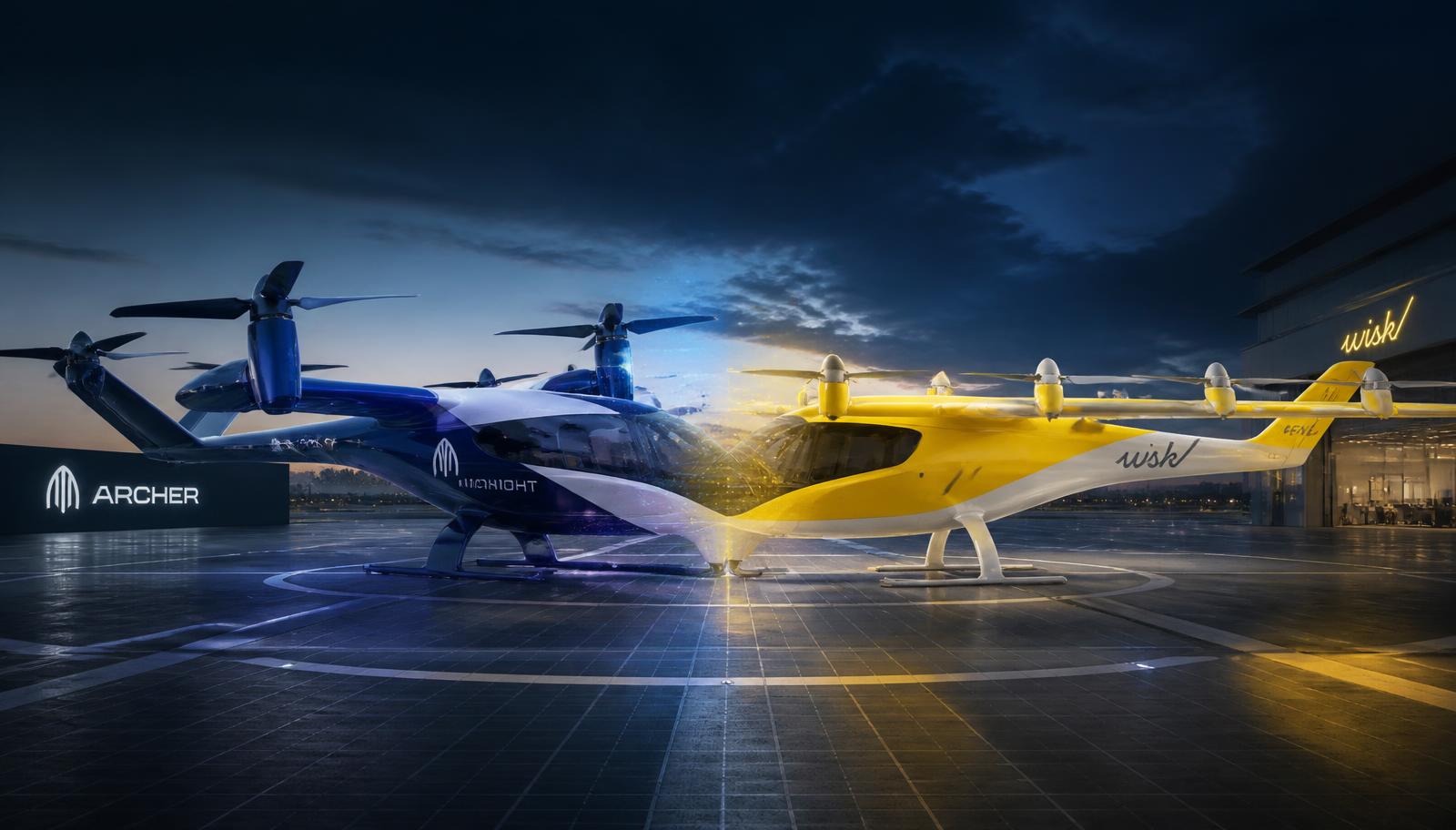
Archer Aviation's acquisition of Wisk, Insitu and SkyGrid, following the launch of Thunder and Halo with Anduril, is more than corporate expansion. It provides an early glimpse into the next phase of Advanced Air Mobility: fewer players, stronger balance sheets, broader technology portfolios and potentially greater vertical integration.
Executive Summary
Archer Aviation's latest moves represent a significant strategic shift from a pure-play eVTOL manufacturer toward a broader aerospace and defense company built around electrification, autonomy and AI.
- Boeing becomes a strategic Archer shareholder:
- Boeing will hold approximately 20% of Archer, gain board representation and retain access to autonomous-flight technology developed within the ecosystem.
- $200M+ in existing annual revenue:
- Insitu gives Archer an established unmanned aircraft business operating across 35 countries, which is profitable generating more than $200 million annually — immediate diversification beyond the emerging commercial eVTOL market.
- Archer enters the transaction from a position of financial strength:
- Q2 ended with $1.56 billion in cash and short-term investments, however, the quarterly cash burn remains significant, with $156 million.
- Archer is becoming a multi-platform aerospace company:
- Midnight is now complemented by the autonomous hybrid-electric Thunder/Halo platform with Anduril, Wisk's autonomy technology, Insitu's unmanned systems, SkyGrid and Archer's ZEE aviation AI platform.
- Boeing sharpens its focus:
- Transferring these businesses allows Boeing to concentrate resources on its core commercial aviation and defense activities while retaining both financial exposure to Archer and access to strategically relevant autonomous-flight technologies.
- AAM consolidation is accelerating:
- Archer, Joby, BETA, Eve and Vertical increasingly stand out as the five major Western independent players. Importantly, these companies are not only better financed — all five have achieved meaningful technical and operational milestones over the past months.
- The supply-chain model may change with consolidation:
- Larger internal engineering organizations and stronger balance sheets could shift the make-versus-buy equation, particularly for engineering and strategically differentiating technologies. Joby is already using this Space-X playbook of vertical integration.
1. The more the merrier - from an Air Taxi Company to an Aerospace Platform
Just WOW, amazing news from Archer Aviation, for years, Archer's story centered around Midnight: certify an electric VTOL aircraft, industrialize it and establish commercial passenger operations.
That remains critical, and Q2 showed tangible progress. Archer completed piloted city-to-city flights between Salinas and Monterey, with each leg taking approximately nine minutes versus more than 35 minutes by car, as it prepares for operations under the U.S. eVTOL Integration Pilot Program.
The more the merrier - Archer's ambition is clearly becoming broader.
At Farnborough, Archer and Anduril unveiled Thunder, a Group 5 autonomous hybrid-electric VTOL aircraft primarily targeting defense applications, together with its commercial derivative Halo. Both share the same airframe, hybrid powertrain and core systems. Out of Autoclave Composite technologies will be crucial to achieving rate output and profitability.
The Boeing Deal adds Wisk with more than a decade of autonomous-flight development. SkyGrid adds autonomous airspace intelligence. Insitu brings an established unmanned aircraft business operating across 35 countries, adding profitable revenue of more than $200 million annually.
Together with Archer's ZEE aviation AI platform, the portfolio now spans electric and hybrid propulsion, autonomy, AI, unmanned systems and airspace management.
Archer has the financial resources to pursue that strategy — but it is expensive. The company ended Q2 with $1.56 billion in cash, cash equivalents and short-term investments, while reporting a $263 million net loss and $156 million of operating cash outflow during the quarter.
Financial Firepower of the Five Western Players
eVTOL OEM liquidity & financial backing overview — latest reported cash / investments and additional backing:
- Joby — ~$2.3B
- Toyota strategic investment
- BETA — ~$1.59B
- Proposed EXIM financing of up to $1B, incl. ~$830M incremental non-dilutive capital
- Archer — ~$1.56B
- Boeing becoming ~20% shareholder
- Eve — ~$403M
- Embraer backing + additional financing capacity
- Vertical — ~$96M
- Financing package of up to $850M, only partially drawn
Figures are based on the latest reported periods and are therefore not fully comparable. BETA and Vertical figures are from Q1 2026; BETA reports Q2 on August 12. Undrawn or proposed financing is not included in reported cash.
Cash, however, only tells half the story. The five remaining Western players have also made substantial operational progress.
Joby has moved increasingly toward real-world operations and market demonstrations, including flights in New York, while continuing preparations for commercial service.
Archer has progressed Midnight into piloted flight and completed its first piloted city-to-city flights while simultaneously expanding into hybrid-electric and autonomous platforms.
BETA has moved beyond pure aircraft development into real-world operations, including the first operational flights under the U.S. eVTOL Integration Pilot Program, while expanding its aircraft, propulsion and defense portfolio.
Eve completed the first flight of its full-scale eVTOL prototype, moving the program into flight testing and toward an extensive 2026 test campaign.
Vertical Aerospace has completed its full prototype flight-test envelope, including two-way piloted transition between vertical and wingborne flight under UK CAA oversight — one of the industry's more significant technical milestones.
The sector is no longer narrowing simply because weaker companies are running out of money. A smaller group is emerging that combines capital, credible aircraft, certification progress and increasingly tangible flight experience.
2. Consolidation Is No Longer a Future Scenario
Developing an aircraft is expensive. Certifying it is expensive. Industrializing it is even more expensive. And all of that while not generating any revenue nor positive cash flow from operations.
Archer's own Q2 illustrates the challenge: the company generated only $5 million of revenue while spending heavily on Midnight certification, manufacturing, hybrid aircraft development and AI. Economics were never likely to support dozens of independent OEMs building parallel engineering organizations, certification programs, production systems and commercial networks. Most of it was driven by the Pre-pandemic SPAC hype, while it is nearly impossible to raise capital in Europe, it was probably too easy to raise capital in the US.
The Wisk transaction is therefore highly symbolic. Only five years ago, Archer and Wisk were competitors and legal adversaries. Now Wisk is becoming part of Archer while Boeing becomes one of Archer's largest strategic shareholders. Inevitably raising another question with stark implications to the Supply Chain:
What happens to Wisk Gen 6?
Archer could find itself simultaneously financing Midnight, Gen 6, Thunder, Halo and future derivatives. Maintaining two overlapping passenger eVTOL programs with separate engineering, certification and supply-chain structures appears difficult to justify - particularly while Archer is already consuming more than $150 million of operating cash per quarter. Some form of rationalization therefore appears likely.
Gen 6 may ultimately prove more valuable for its autonomy software, certification experience, flight-test data, IP and engineering talent than as another standalone passenger aircraft competing internally with Midnight. If we look at previous articles we will find that we have been skeptical all along considering WISK's approach to fly autonomously from day one, essentially extending the pre-revenue runway for potentially too long to be sustainable.
The Western landscape is consequently narrowing around Archer, Joby, BETA, Eve and Vertical, alongside Japan's SkyDrive and an increasingly independent Chinese ecosystem led by players such as EHang, AutoFlight and XPeng AeroHT. Further consolidation, partnerships and program rationalization to be expected.
3. The Supply Chain Could Be Next
Consolidation will not stop at the OEM level. It could fundamentally change the AAM supply chain. Early eVTOL startups relied heavily on external engineering and technology partners because they needed to develop complete aircraft quickly without decades to build traditional OEM capabilities internally. That equation changes as companies consolidate.
Wisk brings a substantial organization of engineers specializing in autonomy, systems, software, flight controls, certification and aircraft integration. Insitu adds decades of unmanned-aircraft engineering and operational experience.
If Gen 6 or overlapping programs are rationalized, those resources can potentially be redeployed across Midnight, Thunder/Halo, ZEE and future Archer programs.
The logical consequence is greater internalization of capabilities previously sourced externally. Interestingly, but not surprisingly, Archer is not alone.
BETA's recently proposed EXIM financing of up to $1 billion explicitly includes funding to increase vertical integration and bring additional strategic aerospace manufacturing processes in-house, while expanding its propulsion manufacturing capacity.
That is an important signal for suppliers. The AAM supply opportunity is not disappearing, but the make-versus-buy boundary is likely to move. As the surviving OEMs mature, strategically differentiating engineering, software, propulsion and integration capabilities may increasingly move inside. Suppliers will need to provide something harder to replicate internally: proprietary technology, specialized know-how, certification expertise or industrial scale.
The same logic applies to capital. The surviving companies are increasingly backed not simply by venture capital, but by strategic aerospace and industrial partners, governments and large structured financing arrangements: Boeing with Archer, Toyota with Joby, Embraer with Eve, EXIM with BETA and significant structured financing for Vertical.
This marks a broader transition for AAM from the first phase – proliferation, dozens of startups, aircraft architectures and ambitious market forecasts. To the second phase which is increasingly about execution and consolidation - fewer OEMs, stronger balance sheets, real aircraft in flight, deeper technology stacks and more mature industrial strategies.
The question is:
Can Archer — and the handful of companies emerging alongside it - turn the technologies developed during AAM's first decade into sustainable aerospace businesses spanning commercial aviation, defense and autonomous flight. That may ultimately be much more consequential than the air-taxi market itself.
Supplementary question:
With Boeing making another move in the AAM space and Embraer owning a majority stake of Eve, will Airbus make a move acquiring a stake in Vertical Aerospace creating a similar (extended) Europe / US duopoly as we have in Commercial Aviation? Time will tell but the odds are not none to zero.
Continue reading
What AAM Developed — And What NGSA Will Scale
ReadThe Next-Generation Single Aisle Will Reshape AAM — Not the Other Way Around
ReadNova Elevation — Separating Altitude from Noise
ReadeVTOLs: Between Ridicule, Opposition, and Acceptance
ReadProgress of AAM in 2025 (so far)
ReadReflecting on the Past Year & Looking ahead - 2025: Separating the wheat from the chaff
ReadIs the Supply Chain Abandoning the AAM Ship?
ReadAdvanced Air Mobility - Dream or Reality?
ReadFARNBOROUGH AIRSHOW - RECAP
ReadNavigating New Horizons: Industry's Strategic Shift Towards Advanced Manufacturing and Sustainability
ReadThe Composite Manufacturing Challenge - Navigating the Quandaries of Scale
ReadThe AAM Industry looking back to a pivotal 2024. The Year of FIRSTS.
ReadNewsletter
Stay ahead of the curve
Occasional analysis on Advanced Air Mobility, eVTOL programs, and the aerospace supply chain. No noise.